.png)
Healthcare Branding: Why Service Names Quietly Decide Your Patient Volume
- 1 day ago
- 3 min read

A patient with chest pain does not search for "Department of Cardiothoracic Medicine." They search for "heart doctor near me," or "cardiologist accepting Aetna," or just "chest pain when to see a doctor." The hospital that names its service "Heart and Vascular Center" wins that search. The one that names it "Department of Cardiothoracic Medicine" does not.
This is not a branding nuance. It is a marketing decision that determines how many of the patients searching for the service actually find it. Most healthcare brand names get this wrong.
The naming mistake most hospitals make

Healthcare service names are usually written by clinicians for clinicians. They are accurate. They are credentialed. They are also invisible to the patients who need them.
The pattern, repeated across hospitals everywhere:
"Comprehensive Joint Replacement Program" instead of "Knee and Hip Replacement."
"Behavioral Health Services" instead of "Therapy and Counseling."
"Diagnostic Imaging Department" instead of "MRI and X-Ray."
"Ambulatory Care Services" instead of "Outpatient Visits."
The clinical names are not wrong. They just do not match how patients search. The marketing penalty is real and measurable. A page titled "Knee Replacement Surgery" will outrank a page titled "Comprehensive Joint Reconstruction" for the queries that drive bookings, by a factor of three to five.
What patients actually search

Patient searches share three traits:
They are specific to the procedure or condition, not the discipline.
They use plain language, not medical terminology.
They often include a qualifier (near me, accepting X insurance, best, urgent).
Service names that mirror these traits perform better. Service names that do not, do not. There is almost no exception.
The three rules of healthcare service naming

Rule 1: Use the word patients use. If patients say "weight loss surgery," do not name your service "bariatric surgery." Use both if needed, but lead with the patient term.
Rule 2: Be specific. "Heart Care" is too vague. "Cardiology, Heart Rhythm and Vascular Care" is better. Specific terms rank for specific searches and convert at higher rates.
Rule 3: Match the booking intent. The name should signal that this is a place patients can go. "Center" works. "Department" feels institutional. "Program" feels academic.
Examples that work, and examples that don't
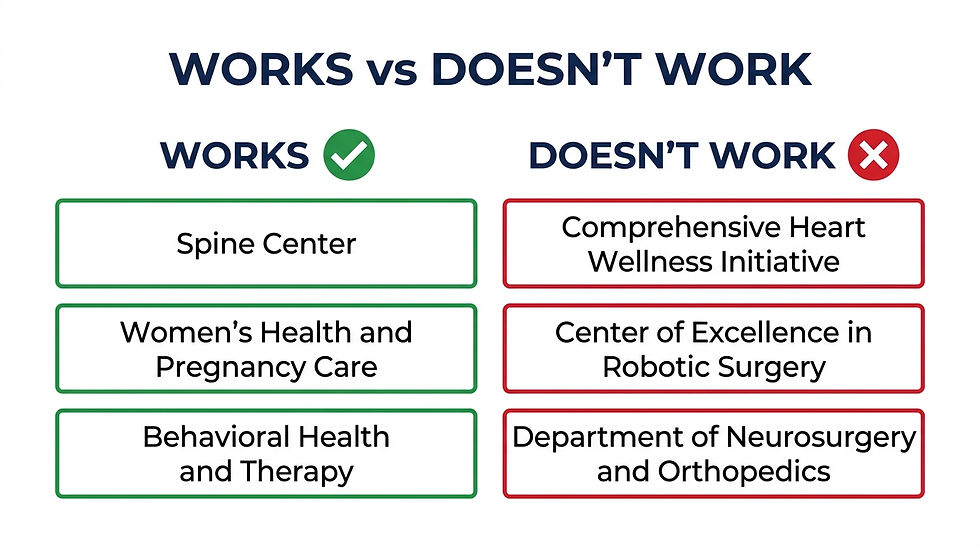
Works: "Spine Center" instead of "Department of Neurosurgery and Orthopedics."
Works: "Women's Health and Pregnancy Care" instead of "Obstetrics and Gynecology Services."
Works: "Behavioral Health and Therapy" with subpages for "Anxiety Treatment," "Depression Treatment," "Couples Therapy."
Does not work: "Comprehensive Heart Wellness Initiative."
Does not work: "Center of Excellence in Robotic Surgery." Patients do not search for robotic surgery. They search for the procedure.
The rebrand decision

A full service-name rebrand is expensive and rarely worth doing for cosmetic reasons. The cases where it is worth it:
Your current service name is showing low search-impression share in Google Search Console.
Your service is launching new providers and competing for new patients.
A competitor is winning your geography for the searches you should be winning.
A safer alternative to a full rebrand: keep the official department name internally, and use a patient-friendly name externally (website page title, Google Business Profile, signage, ad creative). Most hospitals have an "official" name and a "marketing" name, and patients only ever see the second.
Where to start tomorrow
Pull up Google Search Console for your top three service lines. Look at the queries that are showing impressions. If your service name uses words those queries do not contain, your name is leaving traffic on the table.
For more on how patients actually evaluate healthcare brands at the decision moment, see our patient decision journey guide.
If you want a service-line naming audit across your hospital, our team can run one. Often the highest-ROI brand work a hospital can do is rename three pages.


Comments