.png)
Local SEO for Doctors: Rank When Patients Search Near Me
- 2 days ago
- 3 min read

When a patient types "pediatrician near me," Google answers in two parts. First it shows the map pack: three local businesses with stars, hours, and a Call button. Then it shows organic results below. Roughly 70% of clicks go to the map pack. If your practice is not one of those three pins, you are competing for the leftovers.
This is local SEO, and for clinics it's a different game from regular search.
Why local search is different
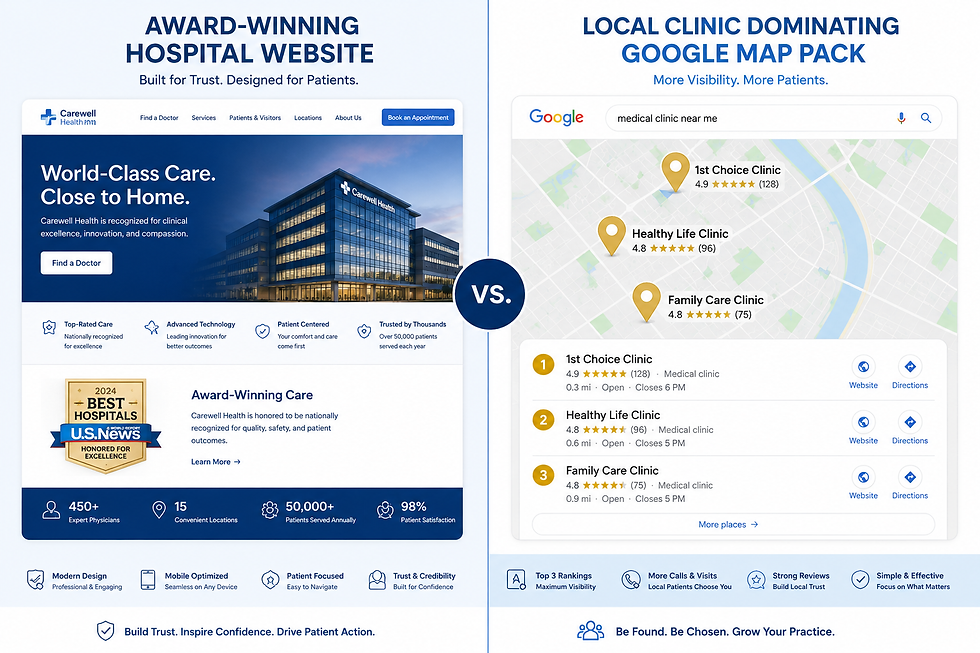
A national keyword like "best knee replacement surgeon" rewards authority, content depth, and backlinks. A local query like "knee replacement surgeon Tampa" rewards proximity, relevance, and prominence, which is Google's three-factor formula for the map pack. You can have the most beautifully written website in the country and still lose to a competitor with a worse site three blocks closer to the searcher.
The good news: most local rankings are won on fundamentals, not budget. A solo practitioner who follows the playbook below can outrank a hospital system in the same zip code.
Google Business Profile is 80% of the work

Most practices treat Google Business Profile (GBP) as a "set it and forget it" listing. Treat it as your second website instead.
Categories matter more than people realize. Your primary category should be the most specific term Google offers for your specialty. Add up to nine secondary categories, but only those you genuinely serve.
Services, photos, and Q&A are ranking factors, not nice-to-haves. Add every service you offer with a one-paragraph description. Upload at least 10 photos of the office, exterior, staff, and waiting room. Pre-empt common questions in the Q&A section before patients post their own.
Posts keep the listing fresh. A weekly 100-word update, such as a new provider, a seasonal vaccine reminder, or an insurance plan now accepted, sends a freshness signal.
Hours, phone, and website must match your site exactly. One typo in the phone number can kill conversions for months.
NAP consistency: the boring thing that breaks rankings

NAP stands for Name, Address, Phone. Google cross-references your listing against dozens of directories, including Healthgrades, Zocdoc, WebMD, Yelp, and your insurance carrier directories, to verify your practice is real. If your address is "123 Main St" on GBP and "123 Main Street, Suite 4" on Healthgrades, that is treated as ambiguity, and ambiguity hurts rankings.
Audit every directory listing once a quarter. Fix discrepancies in the source of truth (your website), then push the corrections downstream.
Reviews are the new word-of-mouth

Three review signals influence local rank:
Volume of reviews on GBP itself, not third-party sites.
Velocity. A steady drip beats a one-time burst.
Response rate. Reply to every review, especially the negative ones, professionally and without disclosing PHI.
A simple review-request system that texts a one-tap GBP review link to patients 24 hours after their visit will move the needle within 90 days. Skip review-gating tools that show negative reviewers a different form. Google penalizes that.
Location-specific landing pages

If your practice has more than one location, build a unique page for each. Embed the relevant Google Map. Include the address, phone, hours, accepted insurance, parking instructions, and bios for the providers who practice there. Generic "Locations" pages with city names dropped into a template don't rank. Pages with genuinely useful, location-specific content do.
Local link building

Forget guest posts. The links that move local rankings come from local sources: chamber of commerce listings, local hospital affiliations, sponsored community-event pages, and the websites of the medical schools your providers trained at. One link from a local university health system is worth fifty from generic medical directories.
Measuring what matters
Skip generic SEO tools and use a local rank tracker (such as Local Falcon) to map your visibility across a grid of points around each office. You'll quickly see where you rank well and where competitors dominate. Optimize for the gaps.
The 90-day plan
Most clinics see meaningful local visibility gains within three months by doing five things consistently: complete GBP optimization, fix all NAP inconsistencies, request reviews after every visit, publish weekly GBP posts, and build five local links. That's it. The clinics that win local search are the ones that do these things every week, not the ones with the most expensive websites.
Want help running this playbook for your practice? Talk to our team.


Comments