.png)
Healthcare SEO 101: How Your Clinic Gets Found by the Right Patients
- May 22
- 3 min read

When a patient has a question about a symptom, a procedure, or a provider, their first move is almost always the same: they open Google. That single moment, typing a query into a search bar, is where most of today's patient journeys begin. If your practice doesn't show up there, you are invisible to the people you are best equipped to help.
The good news: healthcare SEO is learnable. You don't need a hundred-page playbook to start ranking. You need a clear understanding of how Google evaluates medical content, and a short list of the right things to do consistently.
Why SEO is non-negotiable for clinics

Paid ads can drive a spike in bookings, but rankings compound. A page that earns a top position for "pediatric dermatologist near me" will keep generating qualified leads month after month, at a fraction of the cost-per-click you'd pay on Google Ads. For specialties with thin local competition, a single well-optimized page can be worth tens of thousands in lifetime patient value.
Start with intent, not keywords

The biggest mistake clinics make is targeting broad, vanity terms like "dermatologist" instead of the specific phrases patients actually type. Patient queries fall into three buckets:
Informational: "is eczema contagious," "how long does Botox last"
Navigational: "[your clinic name] reviews," "directions to [practice]"
Transactional: "book a teledermatology appointment," "dermatologist in midtown that takes Aetna"
Each bucket needs a different kind of page. Informational queries are answered by blog posts and condition pages built through healthcare content marketing. Transactional queries are answered by service pages with clear calls to action, accepted insurance plans, and pricing transparency wherever possible.
Local SEO: your Google Business Profile is the front door

For most practices, Google Business Profile drives more booked appointments than the website itself. Three essentials:
Claim and verify the listing for every physical location.
Keep hours, phone numbers, and accepted insurance accurate. Inconsistencies hurt rankings.
Ask satisfied patients for reviews, and respond to every one, especially the critical ones. Response rate is a ranking factor.
Embed your Google Map on your contact page, and make sure your NAP (name, address, phone) is identical across the website, the listing, and every directory.
E-E-A-T: why healthcare content is held to a higher bar

Google classifies medical content as YMYL, short for Your Money or Your Life. That means it applies a stricter standard called E-E-A-T: Experience, Expertise, Authoritativeness, and Trust. Practically, this means:
Every condition or treatment page should be authored or reviewed by a credentialed clinician, with their bio and credentials visible on the page.
Cite reputable sources (peer-reviewed journals, CDC, NIH) for medical claims.
Show real provider photos, real reviews, and real outcomes, not stock imagery.
Generic AI-written copy without clinical review will not rank for medical queries. Google's helpful-content systems are trained to detect it.
On-page essentials that actually move the needle
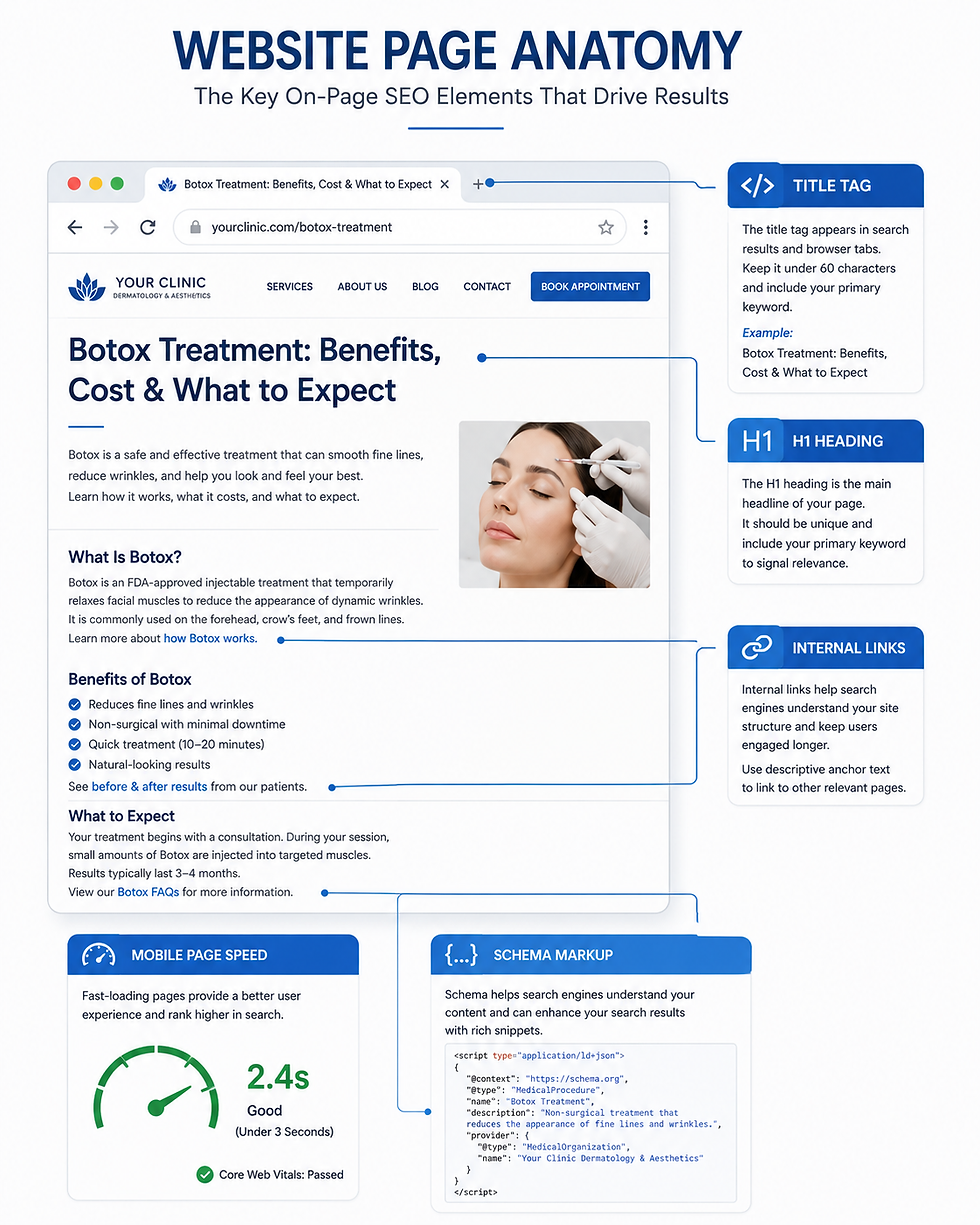
You don't need to chase every SEO trend. Focus on the fundamentals:
A unique, specific title tag and meta description for every page.
One H1 per page that mirrors the searcher's intent.
Internal links from your homepage to your top service pages.
Page speed under three seconds. Most healthcare sites fail this on mobile.
Schema markup for MedicalOrganization, Physician, and FAQPage.
Measure what matters

Track three numbers monthly: organic traffic to service pages, conversion rate from those pages to booked appointments, and review velocity. Vanity metrics like total impressions are noise. Bookings are the only metric that pays the staff.
Where to go from here
Healthcare SEO rewards patience and consistency more than cleverness. Pick one service line, build the best page on the internet for it, earn a few authoritative links, and let it compound. In six months, you'll have a steady stream of patients who found you exactly when they needed you.
If you'd like a free SEO audit of your practice's current visibility, get in touch. We'll show you exactly where the gaps are.


Comments